The fire began just after dawn, at the hour when Santa Monica is wrapped in that brief, fragile quiet that exists before the city wakes. Seagulls were only beginning to stir, the ocean breeze had not yet warmed, and most people were still inside—making coffee, buttoning shirts, lingering in that soft space between sleep and the start of the day. It was the kind of morning when nothing feels urgent. The kind that tricks you into believing danger is far away.
But fires rarely offer warning.
For firefighter Andrew Klein, the shift had started like countless others. He ran through his routine with practiced ease—checking his gear, securing his mask, pulling straps tight. A few of the younger firefighters joked about the station coffee being powerful enough to “bring even the dead back,” and Andrew had laughed, shaking his head. After fifteen years with the department, he had learned that humor was one of the small shields firefighters carried with them to lighten the weight of the work.
He was steady, confident, the kind of firefighter others instinctively followed. Experience had sharpened his instincts until fire itself felt like a language he could read—the way it breathed, the way it consumed, the way it moved with purpose across walls and ceilings.
So when the alarm shattered the quiet—piercing, urgent—Andrew didn’t hesitate. Within minutes, the crew was racing toward a beachside neighborhood, red lights slicing through the gray morning, sirens echoing across empty streets. Even before they arrived, the faint scent of smoke drifted through the truck’s vents, signaling that the situation was already escalating.
By the time they pulled up, flames were leaping from the windows of a small two-story apartment building. Thick black smoke curled upward, staining the sky. Residents were scattered along the sidewalk—coughing, shouting, pointing—fear rising and falling in waves. Amid the chaos, one voice cut through everything.
A woman stood near the curb, sobbing uncontrollably.
“My dog—my dog is still inside! Please, someone, please help her!”
Andrew caught only pieces of her words, but the desperation didn’t need translation. Fear like that was unmistakable.
He gave a single steady nod—no promises, no questions—and sprinted toward the burning structure.
Inside, the fire was a living thing. Heat slammed into him from all sides, rippling through the air in suffocating waves. Smoke curled around his mask, thick enough to swallow his flashlight beam. The crackling roar of flames was punctuated by the groaning of weakening beams overhead. He moved carefully but quickly, sweeping each room, calling out through the muffled fabric of his mask:
“Here, pup! I’m coming for you. Come on, sweetheart!”
Nothing answered but the sound of burning.
Then, just beyond a collapsed section of ceiling, Andrew spotted something—a small shape on the floor, still and silent. He dropped to his knees.
It was a dog. A little black-and-white pup lying motionless in the debris. Her fur was coated with ash; her body limp, almost weightless when Andrew gently lifted her. Later he would learn her name: Nalu.
But in that moment, names didn’t matter. Only life did.
He cradled her against his chest and began the trek back through the burning building. Ceiling panels fell behind him, sparks burst from the walls, and the structure’s heat intensified, pushing harder as though trying to pull him back in. Andrew moved faster.
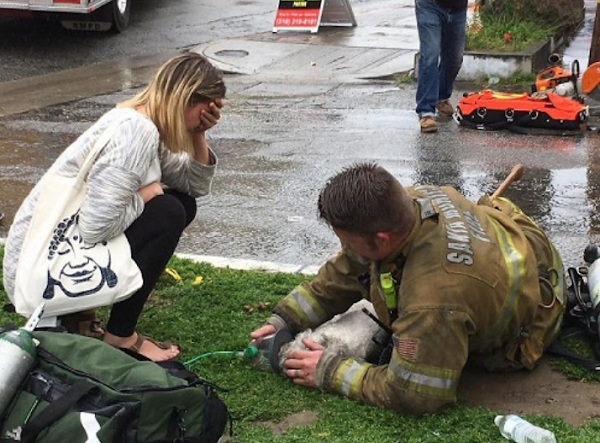
Finally, pushing through the front doorway, he emerged into daylight. Cool coastal air hit him like a shock. The crowd gasped when they saw what he carried. Nalu’s owner collapsed into sobs, hands pressed to her mouth.
But Andrew didn’t stop. He knelt and laid the dog gently on the sidewalk. One glance told him what he feared—Nalu wasn’t breathing.
“She’s not breathing,” he said aloud, though it was mostly to himself. And then training took over.
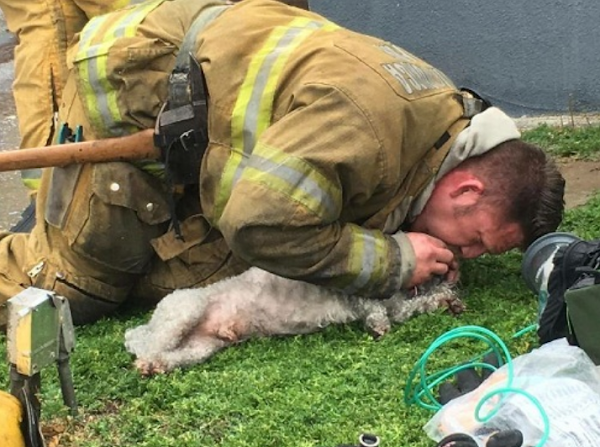
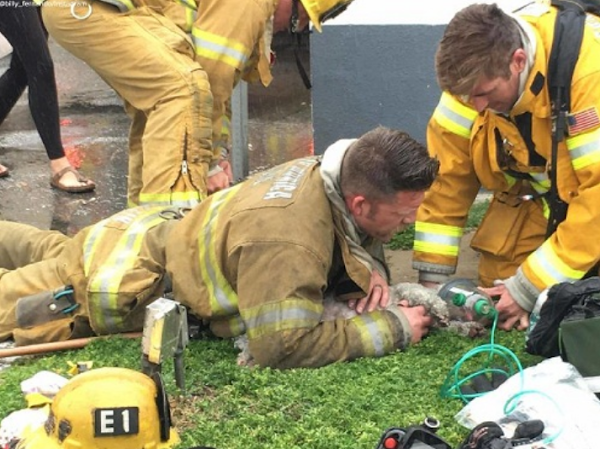
Still wearing heavy turnout gear, Andrew leaned over the tiny dog and began CPR.
Thirty compressions.
Clear her airway.
A breath.
Another.
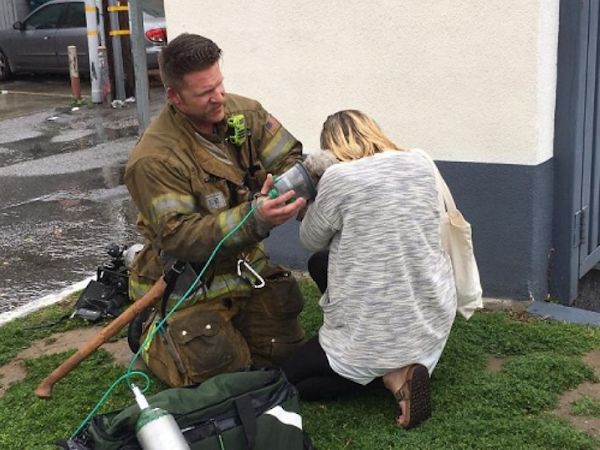
People gathered in stunned silence. A firefighter performing CPR on a dog in the middle of a street—it was surreal, heartbreaking, and unbelievably brave.
“Come on, sweetheart,” Andrew murmured, voice cracking through his mask. “Not today. Don’t quit.”
Another round.
And another.
Nothing.
Seconds thickened into what felt like hours. The woman knelt beside him, shaking, whispering prayers. The other firefighters stood still, holding back the world for just a moment so Andrew could work.
Then—
A twitch.
A faint, barely-there movement of Nalu’s body.
Andrew froze, leaning close.
A small gasp escaped the dog’s mouth.
It was weak, fragile—but it was life.
A ripple of emotion tore through the crowd—sobs of relief, shouts, shaking laughter. Nalu’s owner reached forward as if touching a miracle. Andrew removed his gloves and gently placed his hand on Nalu’s chest, feeling movement—uneven, shaky, but real.
“She’s okay,” he said softly, more breath than voice. “She’s coming back.”
Nalu’s eyes fluttered open, glazed but aware. She let out a trembling whimper, and Andrew stroked her gently, reassuring her in a low voice. She responded with a faint nudge of her nose against his hand.
In that moment the fire behind them, the destruction, the danger—all of it seemed to fade. What remained was the quiet, undeniable truth of what had just happened: a life saved because one man refused to give up.
When reporters later asked Andrew about the rescue, calling him a hero, he only shook his head with a humble smile.
“We’re trained to save lives,” he said. “Doesn’t matter if they have two legs or four. She needed help. That’s all.”
But those who stood there that morning knew better.
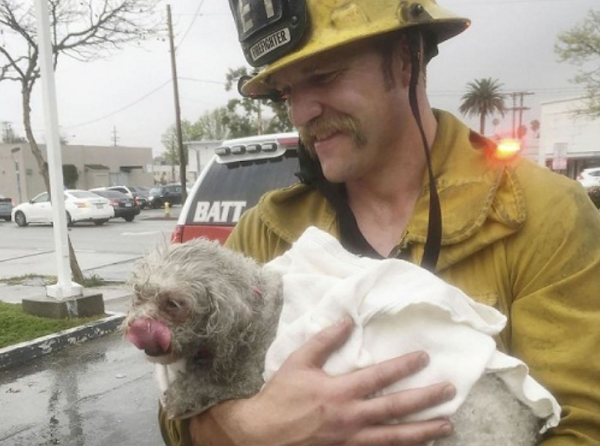
Heroism is not just running into flames. It’s the unwavering belief that every life has value. The willingness to kneel on a sidewalk, lungs burning, refusing to quit until hope returns. It’s courage that shows up without being asked.
That morning in Santa Monica, a dog survived because a firefighter believed she should.
A small life saved.
A powerful act of courage.
And a reminder—from the men and women who show up every day, without hesitation—that as long as there is life to protect, they will run in.
Even when the rest of the world is running out.