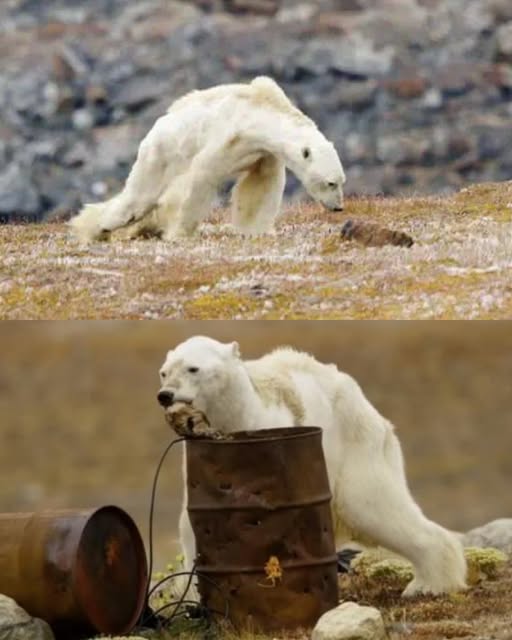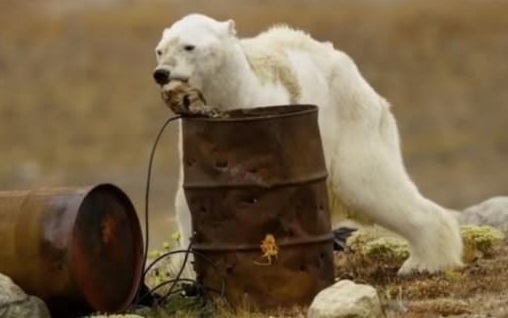
When photographer Paul Nicklen first noticed a pale shape lying motionless on a bed of rocks, he assumed it was debris left behind by the shifting Arctic winds—a torn tarp, a discarded blanket, something lifeless and ordinary. But then it shifted, ever so slightly, and his breath caught. What he had mistaken for an object was a polar bear, reduced to a fragile shadow of the powerful creature it was meant to be.
The bear’s fur hung loosely over its frame, every rib visible, every step a struggle. With slow, trembling movements, it dragged itself across the barren ground, searching for food that the melting ice had stolen away. There were no seals to hunt, no snow-covered platforms to rest upon—only rock, water, and a hunger that had gone far beyond pain. Nicklen lifted his camera, his hands heavy, knowing he couldn’t intervene with food. All he could do was bear witness. His lens didn’t just capture a moment; it captured a warning.
When the footage reached the world, millions of people saw what he had seen: a creature built for survival brought to its knees by a changing climate. For many, this was the moment when climate change stopped being a distant scientific debate and became something heartbreakingly tangible—an image they couldn’t forget.
The polar bear’s struggle posed a silent question that lingers still: If even the strongest animals of the Arctic can no longer find enough to survive, what does that say about our own future? The image remains a stark reminder that the consequences of environmental change are neither theoretical nor far away. They are here, unfolding before our eyes, urging us—pleading with us—to act before the world we know slips away as quietly as the ice beneath the bear’s paws.