In the rugged northern highlands of Thailand, not far from the Myanmar border, the air is thick with the scent of bamboo and burning sunlight. This region—beautiful, green, and deceptively serene—bears scars invisible to most: forgotten landmines leftover from decades of border conflict, buried in soil that still remembers war. It was in this landscape, in 2006, that a tiny seven-month-old elephant calf named Mosha unknowingly stepped into history—though not in the way any creature should have to.
Her life changed in a single shattering instant.
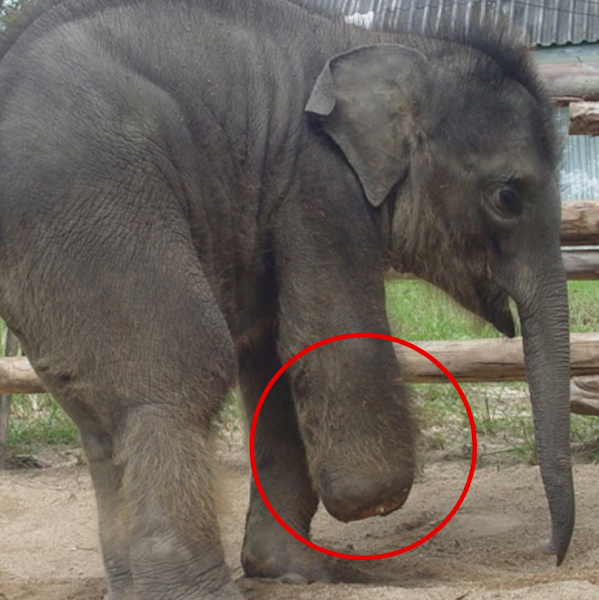
A thunderous explosion ripped through the forest. The ground convulsed beneath her feet, and Mosha was thrown violently onto her side. The blast tore away most of her front right leg, leaving mangled bone and torn flesh where her sturdy pillar of support had once been. A baby elephant’s scream is a sound that can split the soul: high-pitched, desperate, raw with agony. Mosha’s cries carried for miles—echoing off the trees, twisting across the hills, reaching the ears of villagers and rangers who ran toward the sound long before they understood what had happened.
By the time rescuers found her, the forest floor was soaked in blood. Mosha trembled uncontrollably, her trunk groping weakly at the space where her leg should have been. Elephants are profoundly emotional animals; even as a calf, she understood loss. She felt the terror of immobility, the confusion of pain, and the absence of the herd that had fled in panic after the explosion. Her survival in that moment was nothing short of a miracle.
Rescuers wasted no time. They wrapped her wounds, lifted her onto a truck with ropes and makeshift padding, and raced her through winding mountain roads to the Friends of the Asian Elephant (FAE) Hospital in Lampang—the world’s first and only dedicated elephant hospital. It was a place built not simply for medicine, but for mercy.
The veterinarians at FAE assessed Mosha with sinking hearts. Baby elephants rely on their mothers and their herd not only emotionally, but physically—walking long distances daily for food, water, and social bonding. Without a leg, Mosha could not stand properly, balance her growing weight, or move with the herd’s rhythm. Infection from the open wound threatened her life. Perhaps more dangerously, her spirit could break—a slow, silent death of despair.
They predicted she had little chance.
But Mosha’s story was never meant to be one of surrender. It would become a revolution—one sparked not by science alone, but by love stubborn enough to challenge the impossible.
A New Kind of Hope
The team at FAE refused to give up. With every bandage change, every dose of antibiotics, every hour spent comforting the terrified calf, her bond with the caregivers deepened. They saw something in Mosha—curiosity, resilience, a gentle spark that refused to dim. And in return, Mosha saw them not as humans, but as a new kind of herd.
This connection ignited an idea so audacious that no one in the world had ever attempted it: a functional prosthetic leg for a growing elephant.
The complexities were overwhelming. Elephants gain hundreds of kilograms per year. Their movements are heavy, dynamic, and constant. Their legs carry not only weight but emotion; elephants lean into their caretakers, kneel to sleep, lift their bodies to trumpet. How do you build a limb that can withstand all that—especially for a baby who had already endured unimaginable trauma?
Surgeons from FAE partnered with prosthetics experts from Mahidol University. Engineers, veterinarians, biomechanics specialists, and elephant caretakers gathered around a single goal: give Mosha her life back.
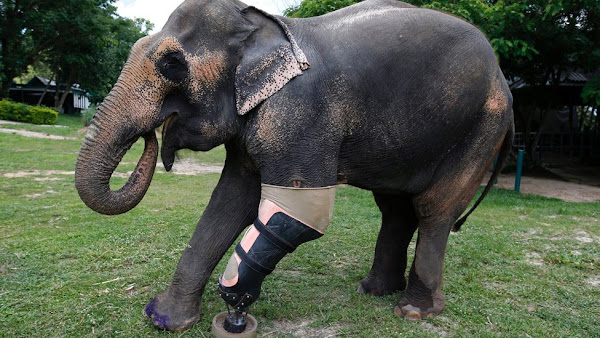
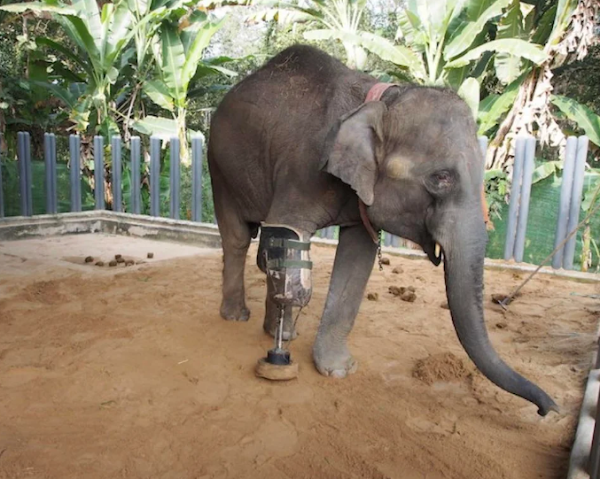
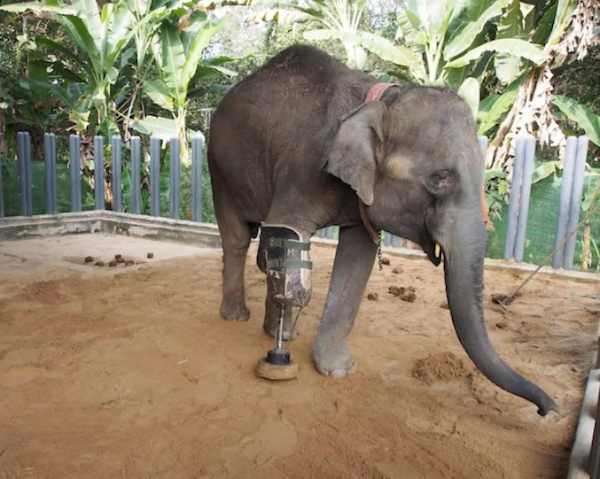
What they designed was revolutionary—a custom prosthetic made of steel, rubber, and thermoplastic, crafted to distribute her weight safely, withstand shifting loads, and adapt to her still-growing body. It was not just a medical device. It was hope made tangible.
The Moment That Changed Everything
Over the next decade, as Mosha grew from 300 kilograms to nearly three tons, the team built more than a dozen versions of her prosthetic. Each one was fitted with care. Each one was met with Mosha’s gentle patience—she would stand quietly, trunk resting on the shoulders of her caretakers, as if sensing the importance of the work being done.
But nothing compared to the moment in 2007 when she received her first fully functional prosthetic leg.
Inside the fitting area, the air was thick with anticipation. Veterinarians adjusted straps. Engineers tightened bolts. Mosha stood waiting, her remaining three legs planted firmly, her trunk curling with nervous curiosity.
Then the prosthetic was finally attached.
The room fell silent. Every eye turned toward the wounded calf who had already survived the unthinkable. Mosha lifted her head, ears flaring wide. She hesitated—a single breathless pause where the entire world seemed to lean forward with her.
And then she shifted her weight.
First a tremble.
Then balance.
Then strength.
With a soft grunt, Mosha stood taller than she had since the day of the explosion. A hush swept across the room. Several staff covered their mouths. One technician whispered, “She’s standing… she’s really standing.”
Then Mosha took her first step.
Clumsy. Wobbly. Miraculous.
Another step.
Then another.
And suddenly, with the unrestrained joy only the very young possess, she broke into a small, triumphant run—straight toward the surgeons who had saved her. Her trunk curled around one man’s waist in a clumsy embrace as the room erupted in sobs. Grown men, hardened by years of tending to wounded wildlife, wept openly. Some fell to their knees. Cameras shook as staff tried to film through their tears.
Mosha trumpeted—a sharp, bright cry of pure happiness. Not a plea. Not a scream. But a song.
She was not just standing. She was living.
A Legacy Larger Than Her Footsteps
Nearly twenty years later, Mosha still lives at the FAE Hospital, racing across grass fields, leaning playfully on her caretakers, and greeting guests with warm, curious eyes. Her prosthetic—now a sleek carbon-fiber model—supports her as she grows older, heavier, stronger.
She has become a global symbol of resilience.
A teaching tool for engineering students.
An ambassador for endangered elephants.
A testament to what happens when compassion refuses to fold under the weight of despair.
Her survival led to breakthroughs in elephant prosthetics worldwide. Other injured elephants, including Motala—another landmine victim—received life-saving artificial limbs because Mosha proved it was possible.
Her story inspired new regulations, anti-landmine activism, and increased funding for elephant hospitals. She changed not only her own fate but the future of prosthetic design for megafauna.
And perhaps most importantly, she reminded humanity of something we too often forget:
Even the cruelest wounds can be met with a kindness strong enough to rewrite fate.
From agony in the forest to joy on a carbon-fiber leg, Mosha’s journey is nothing short of miraculous. She is a survivor not only of violence, but of hopelessness itself. And every time she runs—ears flapping, trunk swinging—the world witnesses a truth that defies destruction:
Miracles sometimes come wearing straps and steel.